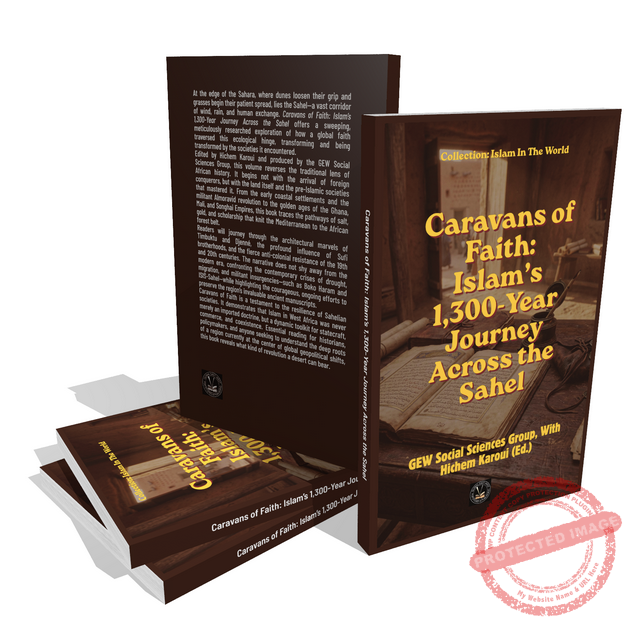
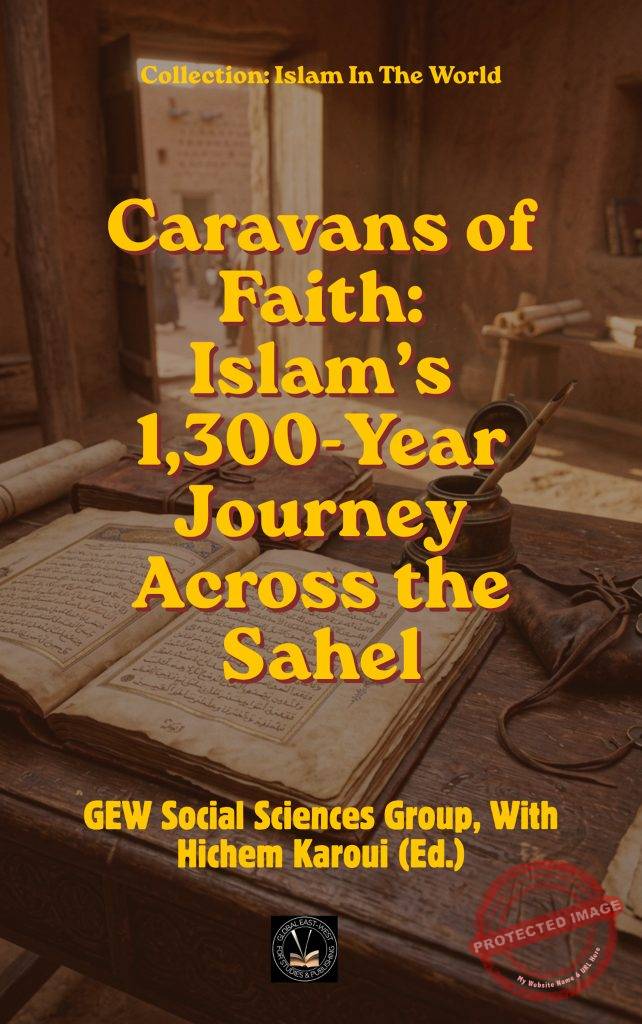
 by GEW Social Sciences Group (Author), Hichem Karoui (Editor)
Part of Collection: Islam In The World.
- Publisher : Global East-West (GEW)
- Publication date : March 30, 2026
- Language : English
- Print length : 234 pages
A sweeping and authoritative historical narrative, Caravans of Faith: Islam’s 1,300-Year Journey Across the Sahel offers readers a profound look at the intersection of religion, commerce, and statecraft in West Africa. Edited by Hichem Karoui and the GEW Social Sciences Group, this book explores how the Sahel—the vast ecological corridor between the Sahara Desert and the African savannah—became a vibrant crucible of Islamic civilization.
The narrative reveals how Islam was integrated into the fabric of Sahelian life over centuries. Rather than a story of simple conquest, this is a history of adaptation. The book begins with the indigenous, pre-Islamic societies that mastered the harsh environment, detailing the complex networks of gold and salt trade. It then tracks the arrival of Muslim merchants, the austere reforms of the Almoravid movement, and the political genius of the Ghana, Mali, and Songhai Empires. Readers will walk the streets of medieval Timbuktu and Djenné, discovering an era where mud-brick mosques served as epicenters of law, science, and manuscript production.
The book transitions seamlessly into the modern age, offering a nuanced examination of Sufi brotherhoods, 19th-century jihadi movements, and the profound disruptions of European colonialism. By charting the transition into post-colonial independence, Caravans of Faith provides crucial context for the challenges facing the Sahel today. It offers an unflinching look at the environmental crises of drought and famine, the emergence of militant insurgencies, and the inspiring, ongoing fight to protect the region’s rich heritage of Islamic manuscripts from destruction.
Perfect for history enthusiasts, academics, and global citizens, Caravans of Faith proves that the Sahel’s history is not just regional, but a vital chapter in the story of global civilization.
Available in different editions:
Amazon: https://a.co/d/06lp2vDR
Universal Link: https://books2read.com/u/mZ9QlJ
Table of contents
Introduction: The Sahel: Geography of a Crossroads
1
At the edge of the Sahara where dunes loosen their grip and grasses begin their patient spread, a long band of land gathers wind, rain, and people into a corridor of exchange. Here, monsoon breath from the Gulf of Guinea pushes north each summer, meeting the dry harmattan that blows south from the desert in winter. Between them lies the Sahel: a skin of savannah and scrub that runs from the Atlantic to the Red Sea, always in movement and always stitching together worlds that might otherwise stand apart. Traders learned to ride its rhythms; scholars and poets set their words to its cadence; and a faith used to caravan routes and caravan time learned to travel.
The Sahel is not a line on a map but a gradient. Its heart lies between rainfall isohyets of roughly 100 to 600 millimetres per year, yet in any generation those bands wander, expanding and contracting with global climate pulses. In some places it is a thorny steppe broken by fig and acacia; in others, a mosaic of millet fields, tiger-bush vegetation, and marshlands that gleam at the end of the rains. From west to east, it crosses what is now Senegal, Mauritania, Mali, Burkina Faso, Niger, northern Nigeria, Chad, Sudan, and Eritrea, with fingers that reach into neighbouring ecologies. Its soils vary from ferruginous hardpans to flood-fed silt; its waters, where they surface, make histories.
Two rivers in particular give the Sahel a spine. The Senegal flows in an arc along the borderlands of the desert, irrigating old polities like Takrur and Futa Toro before emptying into the Atlantic. The Niger performs a more elaborate dance, rising in the Fouta Djallon highlands and describing a grand double bend that encloses the Inland Delta—a seasonal miracle of floodplains, channels, and pools. In the Delta’s watery lattice, fishers, herders, and farmers negotiate time as a resource: Bozo fishers following fish runs with fine-grained calendars; Fulani herders timing transhumance to new grasses; rice farmers harvesting African rice (Oryza glaberrima) where eddies of floodwater slow and sink. Elsewhere, Lake Chad gathers what rivers and seasonal streams can feed it. Though it advances and retreats, it has long acted as a pivot for the Kanem-Bornu region and for trade routes fanning into the desert through the Fezzan and towards Tripoli.
2
It is easy to romanticise caravans as aimless strings of camels wading through dunes. In truth, their paths were as precise as river channels. By the third to fourth centuries of the Common Era, the dromedary had become the technology of connection, its padded feet and water-storing physiology turning the Sahara from a wall into a road. By the early medieval centuries, established routes stitched the Sahel to the Maghrib and, through it, to the Mediterranean and the Middle East. From the Niger Bend one could reach the Moroccan oases by way of Taoudenni and Taghaza, where salt crystallised into castles of trade; from the Lake Chad region, caravans threaded north through the Tibesti and Fezzan to Tripoli; from the Senegal valley, routes climbed towards the Adrar. Oases were not only wells; they were warehouses, meeting-grounds, and points where geographies changed hands.
Along these roads travelled salt, indispensable for life and commerce, hewn in slabs and carried south; gold, panned from the rivers of Bambuk and Bure and carried north in powder and ingots; ivory, kola nuts, leather, ostrich feathers, and copper from Takedda; textiles in return, glass beads, books, and fine metalwork; and, tragically and persistently, enslaved human beings. Goods moved with people, and people brought more than their bodies. Ideas, stories, case-law, technologies, and styles crossed with them, assembling cultures in new combinations. A Tuareg caravan leader might speak Tamasheq and Arabic, trade in Songhay towns, and hold genealogies that link to both nomadic camps and sedentary quarters. A Hausa merchant from Kawar might keep accounts in Arabic script and marry into a family in Agadez, thereby making a bridge between city and desert.
The Sahel’s towns were ports without seas. Timbuktu, Gao, Jenne, Agadez, Walata, Chinguetti, and Kano acted as quays on the littoral of sand. When caravans arrived, markets unfurled with the logic of a tide: sudden abundance, swift negotiation, careful redistribution. Warehouses opened, contract law was invoked, measurements standardised, clerks and scribes summoned. It was in such spaces that Islam’s habitus—prayer times, ablutions, contracts, endowments—found easy purchase. A faith that had grown along routes linking oases and cities found familiar rhythms in these ports of the desert: regular stops, shared calendars, the authority of scripture and of persons invested with knowledge.
3
Before Islam, the Sahel already held histories of movement and exchange. In the early Holocene, when the Sahara was intermittently greener than today, lakes dotted the desert and pastoralists inscribed cattle on stone; as the climate dried, corridors of life retreated south and concentrated around rivers and seasonal streams. Archaeological sites like Jenne-jeno on the Niger attest to urban complexity from the first millennium BCE onwards, with ironwork, specialised crafts, and wide trading links. Across the Atlantic littoral, tidal rice cultivation appears early; inland, pearl millet and sorghum anchor diets. When Islam arrives in later chapters, it will encounter societies that are already cosmopolitan in a local sense—moving within circuits calibrated to ecology, season, and social need.
Ecology and power met at a particular frontier in the Sahel: the frontier of the horse. North of the forest belt, the tsetse fly’s ecological boundary allows horses to thrive, enabling cavalry and the projection of authority at scale. The political formations that rise along the Sahelian arc—from Ghana through Mali and Songhai to Kanem-Bornu— exploit this advantage, forging states whose military mobility matches the demands of an environment in flux. Their capitals face north and south at once: towards the desert for salt and alliance with Maghribi partners, and towards the savannah and forest for gold and labour. This dual orientation is not merely economic; it is ideological, underwriting models of kingship, law, and legitimacy that broker between worlds.
The Sahel is not uniform in its peoples or its languages. Mande-speaking communities span from the upper Niger to the forest edge; Soninke polities occupy strategic positions along the Senegal; Songhay and Zarma anchor the middle Niger; Hausa cities along the trans-Saharan routes flower into a constellation of markets and emirates; Kanuri rule in the Lake Chad basin; Tuareg confederations range across the desert fringe; Fulani herders lace the entire zone, their mobility turning them into an early network of news and trade; Wolof, Serer, Toubou, Zaghawa, Arabicspeaking Shuwa, and many others carry their own cartographies in memory and kinship. This diversity is not incidental: it is a product of a geography that rewards specialism and movement. The Sahel becomes a palimpsest of identities, where Ajami literacies (African languages written in Arabic script), Tifinagh inscriptions, and Arabic scholarship coexist with oral epic and the memory-work of griots.
Weather and work organise Sahelian time. The rains stage everything: planting, transhumance, the timing of caravans, even architecture’s care cycle. Knowledge of the sky mattered, for travellers and farmers alike. Tuareg navigators learned the slow drift of constellations, the rising of Canopus and the Pleiades; cultivators counted the days in ways that interleaved cosmology and agronomy. Islamic calendars, lunar and portable, meshed well with such observational sciences; they also formalised communal time through fasting months and Friday congregations. The adhan ringing from mud-brick minarets was not the intrusion of a foreign clock but another layer in a timekeeping practice that the Sahel had always observed: the world organised by season, horizon, and shared task.
4
This redundancy is a clue to why Islam’s legal and ethical frameworks—its concern with contract, trust, charity, and adjudication—proved useful. A caravan’s survival relied on trust and the ability to settle disputes across cultural lines. Endowments (awqaf) funded schools, wells, and caravanserais; notaries and scholars recorded contracts; shrines and zawiyas, linked to Sufi brotherhoods, offered hospitality to strangers. In many Sahelian towns, the moral economy of Islam converged with local habits of reciprocity. Conversion could be gradual, the adoption of a script before a creed, the recitation of bismillah before a meal long before a profession of faith. The societies of the Sahel were not tabula rasa; Islam’s travel through them shows what happens when a mobile faith meets a mobile land.
It would be naive to paint this history as seamless cooperation. Violence and coercion inhabit the Sahel’s story as surely as wind and rain. Slavery, both as export and as internal institution, marked social and political life; campaigns of jihad and counter-jihad reshaped polities; raids punctuated the margins where pastoral and agricultural frontiers overlapped. The ecology of scarcity sharpened conflict and sharpened skill in managing it. The same mobility that enabled trade and scholarship sometimes enabled predation. To read this landscape well is to see both its solidarities and its fractures.
It is also to recognise that borders are recent. The straight lines that divide the modern Sahel belong more to the surveying table than to the caravan. For centuries, boundaries were negotiated through movement, not fixed by fences. Pastoral corridors, dry-season grazing rights, and flood recession agriculture required cross-cutting claims that modern states, with their paperwork and their militaries, often struggle to accommodate. This book speaks to policymakers as well as historians because it insists that contemporary crises—insurgencies, famine, migratory surges— can be better understood when read against the Sahel’s long grammar of movement. Counter-terrorism strategies that do not take seriously the social ecology of mobility, the sanctity of wells, or the seasonal heartbeat of labour risk mistaking symptoms for causes.
The architectural face of the Sahel tells this story in mud and wood. In Jenne, the Great Mosque’s buttressed walls and protruding beams ask to be renewed with each wet season, a public ritual of maintenance binding neighbourhoods to their monument. In Chinguetti, libraries keep manuscripts safe from sand in rooms whose proportions are tuned to coolness and quiet. In Timbuktu, the mosques of Sankore and Djinguereber mark not only sacred space but scholarly lineages, guardianship of texts and the legal traditions they embody. These buildings are not survivals; they are proofs that this is a civilisation that built in concert with its environment, trusting to repair rather than permanence. It is not a coincidence that the places where Islam takes root most deeply in the Sahel are places that have long practised the art of renewal.
5
What kind of Islam travelled these corridors? One that was confident enough in its texts to make room for local reasoning. The Maliki school of law, strong in North and West Africa, anchored a pragmatic jurisprudence that incorporated custom where it did not violate core principles. Sufi orders, notably the Qadiriyya and later the Tijaniyya, cultivated itinerant pedagogies and social bonds that could span towns and camps: discipleship as a road network. There were also reformist critiques and moments of iconoclasm, chapters in which accommodation yielded to confrontation. Yet the dominant pattern in the Sahel up to the early modern era remained one of translation—linguistic and cultural—and of institutionalisation through education and trade rather than through conquest.
Several heuristics guide the reader through the chapters that follow. First, the Sahel must be seen as a hinge. Its histories rarely begin or end within its own bounds; they swivel between Sahara and forest, Mediterranean and Atlantic, Arabia and the Atlantic islands. Second, ecology is not a backdrop but an actor. Droughts in the twentieth century, the great wet phases of earlier millennia, shifts in the ITCZ—all have political effects. Third, mobility is not the same as chaos. The Sahel’s systems of movement are ordered, normative, and productive, even when they are also sites of contest. Fourth, institutions—market guilds, Sufi zawiyas, emirates, caliphates, colonial administrations—adapt to this mobile order, sometimes amplifying it, sometimes seeking to freeze it into paperwork and parade ground.
It is conventional for studies of the Sahel to begin their stories with a moment of contact: a first merchant, a first conversion, a first building in a recognisable Islamic style. This book reverses the lens. It begins with the land because the land is what makes contact meaningful. When a Berber trader first used a camel to cross a line of dunes that an ox could not, the map was already changed; when a Songhay fisherman learned to navigate the flooded labyrinth of the Delta by reading eddies as sentences, a habit of adapting to flux was already in place. Islam, when it arrives, is not merely a doctrine; it is a toolkit for living together under conditions of distance and uncertainty. Its success in the Sahel cannot be explained by doctrine alone, nor by power alone, nor by trade alone. It rests in the congruence between a faith calibrated to the road and a land that demands travel.
The present intrudes on this narrative as a pressing coda. Today’s Sahel is often described through its crises: as a theatre of insurgency, climate stress, and humanitarian need. These categories are not false, but they are incomplete. The same corridors that carry fighters also carry traders and students; the same networks that supply arms supply paper, pens, and the resolve to keep a school open under a neem tree; the same rivers that fail a harvest also, in their good years, reopen old patterns of abundance. To chart a future that is not only a reaction to crisis, one must understand why certain forms of authority have historically thrived here and why others have fallen flat. Governance that ignores transhumance breaks more than a pastoral economy; it breaks a grammar of life honed across centuries.
6
To stand at sunset on the levee at Timbuktu or on the bluff above the Senegal is to see a geography that makes historians of its inhabitants. The line where the river darkens into sky looks like certainty but is really a negotiation of light and dust. The boats returning with fish slide along routes that change with each season; the mosques shovel shade into the streets; a child walks home with a slate on which letters and verses dry in the heat. Somewhere, in the desert beyond, a caravan camps by a well older than any written document in the region. The wind shifts, and the balance between north and south resets for a few hours. To write the Sahel’s history is to learn to read such moments and to attend to the corridors of life they imply.
In this band of land, monsoon and harmattan conduct a ceaseless dialogue. Rivers write and erase the same letters each year. People move as seasons insist and as memory counsels. Faith walks with them, sometimes in front, sometimes behind, often beside, bearing law and mercy, book and bowl. This introduction has set the scene on which that walking takes place: a geography that is not merely a backdrop but an engine. The Sahel is a crossroads; to understand its Islam is to understand how a crossroads works—how it attracts, how it sorts, how it allows, at its best, strangers to become neighbours without ceasing to be themselves.
BISACs:
HISTORY / Africa / West
RELIGION / Islam / History
SOCIAL SCIENCE / Anthropology / Cultural & Social
SOCIAL SCIENCE / Regional Studies
POLITICAL SCIENCE / General
