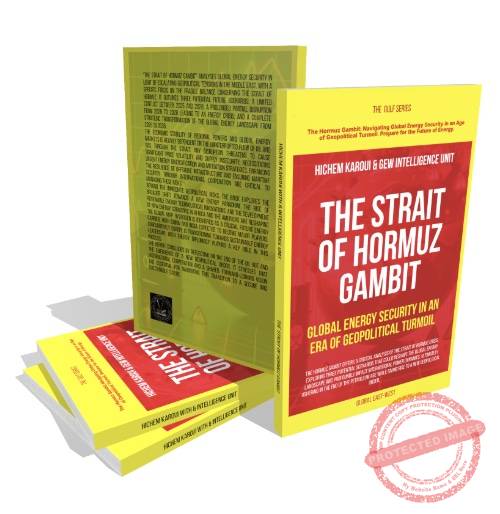
Hichem Karoui and GEW Intelligence Unit 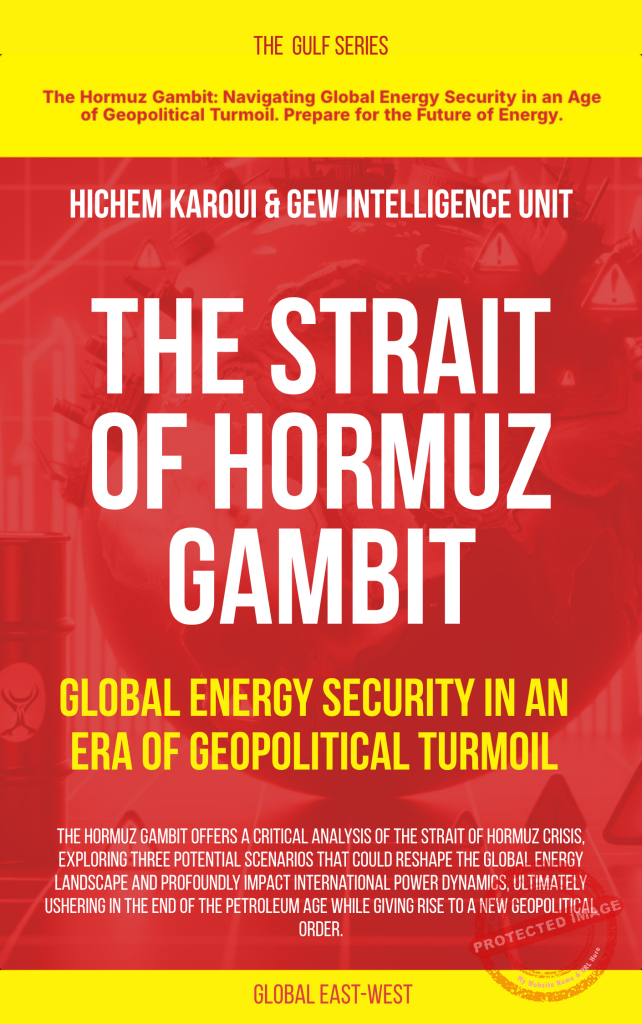
- Publisher : Global East-West (London).
- Publication date : July 1, 2025
- Language : English
- Print length : 180 pages
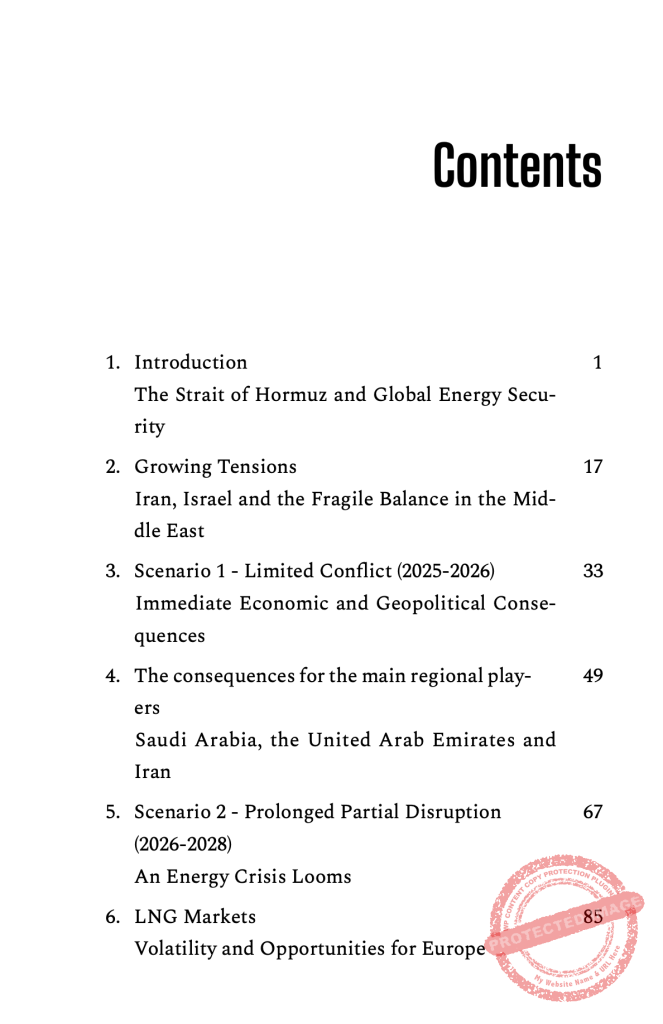
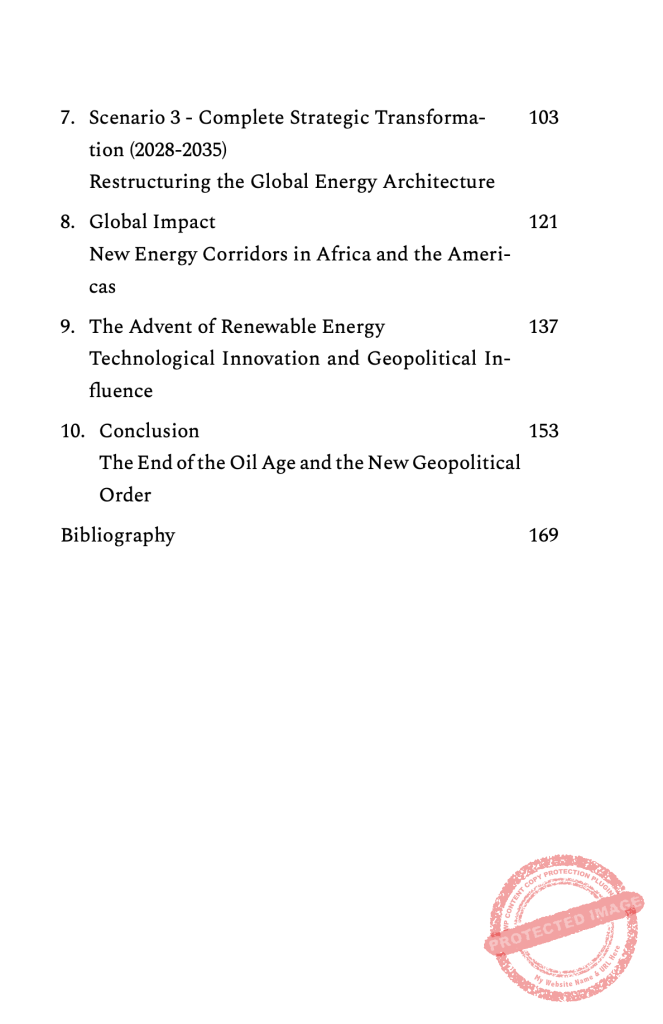
“The Strait of Hormuz Gambit” analyses global energy security in light of escalating geopolitical tensions in the Middle East, with a specific focus on the fragile balance concerning the Strait of Hormuz. It outlines three potential future scenarios: a limited conflict between 2025 and 2026; a prolonged partial disruption from 2026 to 2028 leading to an energy crisis; and a complete strategic transformation of the global energy landscape from 2028 to 2035.
The economic stability of regional powers and global energy markets is heavily dependent on the uninterrupted flow of oil and gas through the strait. Any disruption threatens to cause significant price volatility and supply insecurity, necessitating urgent energy diversification and mitigation strategies. Enhancing the resilience of offshore infrastructure and ensuring maritime security through international cooperation are critical to managing these risks.
Beyond the immediate geopolitical risks, the book explores the broader shift towards a new energy paradigm. The rise of renewable energy, technological innovations, and the development of new energy corridors in Africa and the Americas are reshaping the global map. Hydrogen is identified as a crucial future energy carrier, with China and India expected to become major players. Concurrently, Europe is transitioning towards sustainable energy leadership, with energy diplomacy playing a key role in this process.
The report concludes by reflecting on the end of the oil age and the emergence of a new geopolitical order. It stresses that international cooperation and a shared, forward-looking vision are essential for navigating this transition to a secure and sustainable future.
The Strait of Hormuz Gambit* is an essential read for anyone interested in the interconnection between regional strife, global economics, and the evolving landscape of international energy security.
BISACs
POLITICAL SCIENCE / International Relations / General
POLITICAL SCIENCE / World / Middle Eastern
POLITICAL SCIENCE / Geopolitics
BUSINESS & ECONOMICS / Industries / Energy
TECHNOLOGY & ENGINEERING / Power Resources / Alternative & Renewable
The book in available in various editions:
Amazon: https://a.co/d/0912Z1t4
Universal URL:https://books2read.com/u/mgMPPv
Introduction
The Strait of Hormuz and Global Energy Security
Historical and Geopolitical Context of the Strait of Hormuz
The Strait of Hormuz has always been a key hub for maritime trade, connecting the Arab-Persian Gulf to the Indian Ocean. Over the centuries, this strategic passage has played a crucial role in trade between the East and the West. Ancient civilisations, including the Mesopotamians and Persians, recognised the vital importance of this waterway. However, it is in recent decades that international attention has focused sharply on the security and stability of this key region. With a large share of the world’s oil flowing through this narrow strait, the geopolitics of the region have made it a hot topic of concern for regional and international actors. Historical tensions between some of the regional powers, such as Iran, Saudi Arabia and the United Arab Emirates, as well as the global interests of major powers, make the Strait of Hormuz a complex and often volatile geopolitical theatre. Furthermore, recent political and security developments in the region have heightened questions and concerns about the free movement of merchant ships through these strategic waters. In this context, an in-depth analysis of the historical and geopolitical context of the Strait of Hormuz is essential to understand the present and anticipate the future of this region, which is so crucial to the global economy.
The Strategic Challenge: A Crucial Maritime Passage
The Strait of Hormuz, a true geostrategic crossroads, is a crucial maritime passage at the heart of global challenges. Connecting the Arab-Persian Gulf to the Sea of Oman, it spans a maximum width of only 39 kilometres. This narrowness makes the passage vitally important for the transit of energy resources, particularly oil and gas, whose regular flow has major global repercussions.
The geographical location of the Strait of Hormuz poses unparalleled challenges for navigation and maritime security. Trade flows through this sea lane are subject to constant surveillance by multiple regional and international actors. However, political tensions and geopolitical rivalries exacerbate security concerns, weighing on the stability of the region and global markets.
This strategic route is also the scene of power games between major powers seeking to secure access to energy resources while ensuring the free movement of ships in the area. The fragile balance in this sensitive area highlights the major strategic importance of the Strait of Hormuz, forcing international actors to reconsider their positions and alliances.
The protection of economic and geopolitical interests in this crucial region is therefore a key concern for the world’s major players. As a result, diplomatic and military developments in the Strait of Hormuz directly influence global energy security, prompting serious reflection on the economic models and security strategies of the states concerned.
Key Players: Regional Powers and International Influence
 The turbulent waters of the Strait of Hormuz are steeped in the complexity of relations between regional players and international powers. The proximity of this strategic passage to major countries such as Iran, Oman, the United Arab Emirates and Saudi Arabia makes it a key geopolitical theatre. Each of these actors has specific interests related to energy security, maritime trade and regional influence. Iran, as the predominant regional power, considers partial control of the strait to be a trump card in its political game. At the same time, the Gulf monarchies fear Tehran’s rise in power and seek to guarantee the security of their oil exports. This regional rivalry is part of a broader context of clashes of influence between Iran, the United States, China and the European Union. The US military presence in the region, the EU’s diplomatic efforts to preserve the nuclear agreement and China’s economic ambitions add layers of complexity to this theatre of conflicting interests. The key question is whether the key players will be able to maintain a fragile balance while avoiding the conflagration of a region already marked by conflict. Regional and international collaboration on the management of this vital passage is imperative to prevent any escalation of tensions that would threaten global energy stability. As the situation evolves, interactions between these key players will continue to shape the geopolitics of the Strait of Hormuz and have repercussions on the global balance of power.
Diplomatic Dynamics: Dialogue and Persistent Tensions
The diplomatic dynamics surrounding the Strait of Hormuz, a strategic crossroads of national and international interests, are characterised by nuanced dialogue and persistent tensions. Regional powers such as Iran, the United Arab Emirates and Oman, as well as dominant international actors such as the United States, Russia and China, are engaged in a complex game of negotiations and assertions of influence, while navigating cautiously between cooperation and rivalry. Multilateral dialogues aimed at preserving freedom of navigation and easing economic and political rivalries remain tenuous in the face of historical antagonisms and conflicting aspirations. Diplomatic rhetoric alternates between calls for de-escalation and demonstrations of strength, reflecting a constant search for balance between national interests and regional security imperatives. At the same time, persistent tensions stem from complex geopolitical disputes involving shifting alliances and geostrategic issues that are crucial to global stability. Persistent differences over nuclear agreements, territorial disputes and economic rivalries fuel a climate of mutual mistrust and uncertainty about the future of the vital Strait of Hormuz. In this regard, the diplomatic balance remains fragile, subject to shifting regional and global power dynamics. The intensity of the issues crystallising around the Strait of Hormuz requires continued vigilance and concerted diplomacy to prevent any escalation that could undermine global stability and the global energy balance.
Economic Impact of Oil and Gas Flow
The smooth flow of oil and gas through the Strait of Hormuz has a significant influence on global energy markets and the financial stability of regional players. Fluctuations in this flow have major economic repercussions worldwide, affecting the financial stability of exporting countries, energy costs for end consumers, and the competitiveness of industries dependent on oil and gas.
Volatility in flow, resulting from geopolitical tensions or technical disruptions, creates uncertainty in international markets, leading to rapid price fluctuations and supply insecurity. Even a temporary sharp drop in oil flow can be enough to cause global oil prices to spike, negatively impacting economies that are heavily dependent on this resource. Similarly, a persistent threat to strategic shipping routes hinders the predictability of liquefied natural gas supplies, exacerbating the risk of shortages and price increases.
Beyond immediate fluctuations, uncertainties surrounding oil and gas flows undermine long-term energy investment planning for both producers and consumers. Hesitation in decision-making and constant adjustments to production dynamics are slowing the development of new energy infrastructure, thereby increasing the obstacles to a gradual transition to alternative and renewable sources. This directly impacts the diversification of national economies and greenhouse gas emission reduction targets.
In short, the economic impact of oil and gas flows through the Strait of Hormuz extends far beyond regional borders to shape the contours of the global economy. The security and stability of this strategic passage is therefore crucial to ensuring the smooth flow of energy resources and avoiding turbulence that disrupts global financial stability.
Offshore Infrastructure: Logistical Risks and Resilience
Offshore infrastructure, technological marvels that serve the global energy supply, are at the heart of a complex dance between logistical risks and resilience. These facilities, whether offshore oil or gas platforms, are an essential link in the global energy supply chain, but their safety and uninterrupted operation face a myriad of challenges. Harsh maritime conditions, geopolitical threats, environmental risks and the technical challenges inherent in their operation and maintenance require constant vigilance and cutting-edge expertise. The combination of these factors makes offshore infrastructure particularly sensitive areas, where fragile balances are at play on a daily basis.
The risks to these complex structures are manifold. Violent storms and extreme weather conditions constantly test the structural and operational integrity of these installations. In addition, the presence of coveted energy resources makes them potential targets for sabotage or deliberate attacks, fuelling underlying geopolitical tensions. Furthermore, the protection of the marine environment is crucial, as even the smallest leak or accident can have catastrophic consequences for marine and coastal ecosystems. Finally, the upkeep and maintenance of these infrastructures require highly specialised expertise, which is also a major challenge in a context of limited human resources and staff turnover.
In the face of these risks, the logistical resilience of offshore installations is proving to be a determining factor. Advanced risk monitoring and management systems are being deployed to detect potential threats and anticipate critical situations. In addition, strict safety procedures and incident response protocols are constantly monitored, helping to minimise the consequences of any uncontrolled events. Technological innovation also plays a key role in improving safety standards, with the development of advanced detection devices, resistant materials and cutting-edge engineering practices.
In short, offshore infrastructure is both a vital link in the global energy chain and a fragile territory exposed to a multitude of risks. Securing it and ensuring its uninterrupted operation requires a holistic approach combining technical expertise, international cooperation and ongoing innovation. In a context of energy transition and geopolitical volatility, the sustainability of this infrastructure remains a major challenge for the stability of global energy supplies.
Maritime Security: Cooperation or Confrontation?
Maritime security in the Strait of Hormuz region is a matter of paramount importance, not only for regional actors but also for the rest of the world. The question of whether it should be addressed through cooperation between the various maritime powers or whether it risks turning into direct confrontation is at the heart of the debates and strategies implemented by the actors involved. The porosity of maritime borders, combined with the concentration of oil and gas traffic, creates an environment conducive to tensions and rivalries. In this context, it is imperative to assess the options available to ensure the safety of navigation without compromising regional stability. Cooperation between the naval forces of coastal countries and those of extra-regional powers has been suggested as a possible solution. However, the divergent interests of the actors involved make it difficult to establish such a maritime security mechanism. At the same time, the temptation to resort to unilateral means to protect national interests raises concerns about escalating tensions and the risk of confrontation. Recent incidents, such as ship seizures and aggressive manoeuvres, have fuelled fears of excessive militarisation in the region. Thus, the question of whether maritime security in the Strait of Hormuz will be managed through multilateral cooperation or whether it will lead to potentially dangerous confrontations remains an enigma. A balanced approach, based on dialogue and diplomacy, seems to be the most prudent course of action to avoid a precarious situation of conflict.
Technological Developments: Surveillance and Defence
Technological developments in the field of surveillance and defence have profoundly reshaped the maritime strategies of the actors involved in the security of the Strait of Hormuz. Indeed, rapid advances in artificial intelligence, underwater robotics, sensor networks and surveillance satellites have offered new perspectives for the protection of strategic sea lanes.
The advent of automated surveillance systems has enabled increased vigilance and faster response times to emerging threats. Autonomous vessels equipped with advanced detection technologies have become major assets in securing commercial traffic, providing a discreet but effective presence in the maritime domain.
At the same time, innovations in the field of defence have given rise to new paradigms in deterrence and risk management. Electronic jamming techniques, sophisticated anti-ship missile systems and counter-mine devices have strengthened the ability to protect shipping lanes, while imposing a new balance in the balance of power.
Furthermore, the integration of cybersecurity technologies into defence systems has radically transformed the parameters of maritime conflict. The growing vulnerability of the IT networks of port facilities, oil platforms and command centres has created an imperative for preparedness and resilience in the face of cyber attacks.
However, these technological advances also raise questions about their potential use in confrontational contexts. The proliferation of armed naval drones, stealth submarines and sophisticated electronic warfare capabilities poses major ethical and security challenges, calling for rigorous international regulation to prevent any escalation of tensions.
In the face of these constant developments, multilateral cooperation in the field of surveillance and defence appears to be essential to guarantee the safety of critical maritime routes. Information sharing, the establishment of incident prevention mechanisms and the harmonisation of safety standards are essential levers for collective risk management. In this context, the interoperability of surveillance systems and the coordination of maritime security operations are major priorities in addressing the contemporary challenges of global navigation.
Disruption Scenarios: Analysis and Outlook
When addressing the issue of the Strait of Hormuz and its potential disruption, it is imperative to examine possible scenarios through an analytical lens informed by geopolitical foresight. The first scenario is based on a series of minor incidents temporarily affecting the flow of energy resources through the strait—a challenge that the international community should be able to manage without causing major disruption. However, if these incidents continue or multiply, we could see a second scenario emerge, characterised by prolonged partial disruption, leading to significant economic repercussions and prompting global actors to consider emergency measures to mitigate sudden shortages. Finally, the most extreme scenario, although speculative, envisages a complete strategic transformation of the global energy landscape, with the strait being bypassed by new energy corridors, causing major geopolitical upheaval. These scenarios, although speculative, require serious attention from policymakers and analysts, as they highlight the need to prepare energy mitigation and diversification strategies in the face of potential instability. Thus, the relevant authorities must grasp the crucial importance of understanding these potential disruption scenarios in order to develop effective policies that will help strengthen global energy security in a context of increased volatility.
Global Consequences: The Energy Transition Put to the Test
The prospect of major disruptions in the Strait of Hormuz, and by extension to global energy security, is raising legitimate concerns about the potential consequences for the ongoing energy transition. This period of uncertainty is exacerbating debates and decisions related to investments in renewable energy and reducing dependence on fossil fuels. Crisis scenarios in the Strait of Hormuz highlight the urgent need to diversify energy sources and strengthen infrastructure resilience in the face of such events. Indeed, a prolonged disruption of oil and gas flows through the strait could lead to major economic upheavals, affecting not only the countries directly involved, but also global markets and geopolitical stability. The question of the global consequences of these disruptions raises fundamental issues for the future of the energy transition. On the one hand, a prolonged interruption or significant increase in the costs of hydrocarbon transit could accelerate investment in energy alternatives, such as renewable energies, thereby stimulating innovation and competitiveness in this sector. On the other hand, the repercussions on global markets could lead to additional geopolitical tensions, exacerbating rivalries between regional and international players for access to resources and control of new energy corridors. The energy transition is therefore being tested by these potential scenarios, faced with the need to accelerate its pace while ensuring a fair and peaceful transition. Furthermore, this situation highlights the crucial importance of rethinking global energy governance in order to ensure international cooperation and prevent conflicts over access to strategic resources. In the face of these challenges, it is imperative to adopt an integrated approach, combining economic, political and technological strategies, to shape a resilient and sustainable energy future.
***
References
Baldwin-Edwards, Martin. Energy Security in the Gulf: The Future of Oil and Gas Exports from the Arabian Peninsula . London: Palgrave Macmillan, 2021.
Ehteshami, Anoushiravan, and Naser al-Tamimi. “The Strait of Hormuz and the Gulf’s Strategic Significance.” Middle East Policy 25, no. 3 (2018): 45–62.
U.S. Department of Defense. Annual Report on Military Power of Iran . Washington, D.C.: Office of the Secretary of Defense, 2023.
U.S. Energy Information Administration (EIA). “The Strait of Hormuz Is the World’s Most Important Oil Transit Chokepoint.” Last modified July 26, 2023. https://www.eia.gov/todayinenergy/detail.php?id=57241 .
Growing Tensions
Iran, Israel and the Fragile Balance in the Middle East
Historical Context: Origins of Conflicts and Antagonisms
The Middle East region is marked by a complex colonial legacy, resulting from Western domination and influence over the past centuries. The consequences of the First World War and the break-up of the Ottoman Empire led to the arbitrary redrawing of borders, creating tensions among various ethnic, religious and political groups. Historical rivalries between groups such as Arabs and Persians, as well as sectarian divisions, were exacerbated by this foreign interference, laying the foundations for the current conflicts. The emergence of the State of Israel in 1948 also triggered decades of tension and violence, fuelled by conflicting territorial claims and deep cultural differences. The Israeli occupation of disputed territories has fuelled persistent Palestinian resistance, contributing to regional instability. The interference and geopolitical interests of major world powers, such as the United States and Russia, have added further complexity to this already tumultuous landscape.
Key Players: Regional Powers and Multipolar Influences
The Middle East region is the scene of complex political rivalries involving a multitude of key players, each seeking to promote its strategic interests in an often tumultuous geopolitical landscape. Among these players, Iran stands out as a major regional power, exerting significant influence over affairs in the Middle East. Its involvement in regional conflicts such as the civil war in Syria and disputes in Lebanon, as well as its proximity to Israel, fuel widespread geopolitical tensions. In addition, Iran maintains strategic relations with non-state actors such as Hezbollah, further strengthening its multifaceted influence. At the same time, Israel remains a key force in the region, with proven military capabilities and strong international alliances. Long-standing rivalries between Iran and Israel have created a climate of mistrust and competition that constantly shapes the political landscape of the Middle East. These regional powers operate in a multipolar context in which other international actors are also involved. The United States plays a leading role, providing unwavering support to Israel while adopting a position of mistrust towards Iran. Russia has expanded its spheres of influence by forging strategic partnerships with Iran and other regional players, while China seeks to consolidate its economic interests in the region by developing trade and energy ties. In short, the geopolitical dynamics in the Middle East are strongly influenced by the complex interactions between these regional powers and the multiple international forces operating there, shaping a delicate and unstable balance whose repercussions extend far beyond the region’s borders.
Shadow War: Espionage and Cybersecurity
In the corridors of power, modern wars are no longer confined to physical territories, but now extend to digital territories. Espionage and cybersecurity have become major issues in the dynamics of geopolitical tensions in the Middle East. The growing sophistication of cyber capabilities has redefined the boundaries of conflict, introducing a new battlefield where states and non-state actors compete to consolidate their supremacy. In this shadow war, major powers are investing heavily in the development of cyber armies capable of operating in the relative anonymity of cyberspace.
Espionage, meanwhile, is of unquestionable strategic importance. Intelligence agencies are engaged in a relentless struggle to gain access to sensitive information and destabilise their opponents’ structures. Clandestine alliances are being forged, disinformation operations are multiplying and networks of infiltrated agents are proliferating. This shadow war is also being waged on the technological front, with the deployment of sophisticated malware designed to undermine defence systems and disrupt critical infrastructure.
At the heart of these issues lies the crucial question of cyber security. Targeted cyber attacks, hacking attempts and digital propaganda campaigns are all threats that states must face in order to preserve their integrity and sovereignty. The quest to develop effective defensive strategies requires cutting-edge expertise and considerable resources, but remains subject to constant change as technology advances.
Thus, the shadow war, whether waged through traditional espionage or cyber operations, further complicates the already fragile balance in the Middle East. It highlights the urgent need for regional and international actors to rethink their strategic approaches and develop regulatory mechanisms adapted to this new conflictual reality.
Religious Tensions and National Identities
Religious tensions and identity conflicts in the Middle East are deeply rooted in the complex history of the region. For centuries, religious differences have often been used as political levers to influence social, political and geopolitical dynamics. Indeed, rivalries between different branches of Islam, Sunni and Shia, as well as historical tensions between Jewish and Muslim communities, contribute to the region’s instability. National identities intertwine with these religious tensions, creating a complex environment where territorial claims and nationalist aspirations fuel potential conflicts. Therefore, it is crucial to understand these deep-rooted tensions in order to fully grasp the dynamics of international relations in the Middle East. Religious conflicts and identity claims are often exploited by various state and non-state actors in pursuit of their political and geostrategic interests. The manipulation of national and religious identities creates divisions within societies and exacerbates antagonisms, further weakening the already precarious regional balance. These tensions can also extend beyond national borders, fuelling transnational conflicts and blurring the traditional boundaries of geopolitical issues. Faced with these highly complex challenges, it is imperative to adopt a nuanced approach that recognises both religious and identity realities while seeking avenues for dialogue and reconciliation. Understanding the deep roots of these tensions must guide strategies aimed at resolving crises and establishing lasting foundations for peace and stability in the region. This requires challenging simplistic mindsets and a genuine commitment to recognising cultural and religious diversity. By demystifying stereotypes and promoting an inclusive vision, it is possible to lay the foundations for peaceful and harmonious coexistence based on mutual respect and human dignity.
Diplomacy and Sanctions: A Subtle Balancing Act
Diplomacy and sanctions are a complex arena where delicate balances are at play. In the context of growing tensions between Iran, Israel and other regional actors, diplomatic efforts to contain antagonisms and promote peaceful solutions are essential. However, the imposition of economic sanctions is also a major strategic tool in this delicate balancing act. Sanctions, whether unilateral or multilateral, aim to exert economic and political pressure on a state or group of actors to influence their behaviour. They can take various forms, such as trade restrictions, financial restrictions or export bans. Their impact is significant, affecting both the targeted governments and civilian populations. Thus, the implementation of sanctions requires careful analysis to assess their intended and collateral effects. In the context of the Middle East, where historical rivalries and geostrategic issues are intertwined, the implications of sanctions are profound. Diplomatic negotiations aimed at resolving tensions and avoiding open conflict must contend with the challenges posed by the use of sanctions. International cooperation, particularly within bodies such as the UN and other regional organisations, is central to these dynamics. Reaching consensus on the nature and scope of sanctions is therefore a complex process involving compromise and careful deliberation. Furthermore, efforts to maintain open channels of communication, despite differences, are fundamental to preserving opportunities for dialogue and mediation. The effectiveness of sanctions as an instrument of coercion depends on their credibility and legitimacy. Consequently, diplomatic actions surrounding the imposition and lifting of sanctions are subject to constant re-evaluation. Ultimately, diplomacy and sanctions represent a game in which caution and insight are required. Their complex interaction reveals the nuances of international dialogue and highlights the crucial issues underlying relations between state and non-state actors.
Military Rhetoric: Discourse and Statements
Military rhetoric plays a central role in international relations, particularly when it comes to growing tensions between Iran, Israel and the fragile balance in the Middle East. Speeches and statements by the leaders of these nations have a profound strategic dimension, often intended to strengthen internal legitimacy, deter potential adversaries, or mobilise national and international public opinion.
The language used in military speeches is often laden with symbols and historical references, aimed at placing present actions within a narrative continuum, projecting an aura of power, or even provoking an emotional response in the audience. Political and military leaders thus skilfully wield words, exploiting the power of rhetoric to influence perceptions and attitudes.
In the specific context of the Middle East, where historical and geopolitical rivalries are heightened, military rhetoric takes on a particular significance. Veiled threats, warnings and assertions of strength can lead to an escalation of tensions, stimulate military preparations and influence political decisions. Statements about military capabilities, strategic alliances and operational intentions are never just words thrown into the air, but cornerstones on which the conflictual and cooperative dynamics of the region are built.
However, this rhetoric is not simply an exercise in strategic communication. It is part of a broader context of complex international relations, subject to multifaceted pressures and rapid change. Thus, speeches and statements are not only instruments of intimidation or persuasion, but also signals that international actors deploy to probe their adversaries, assess the limits of escalating tensions, or even explore spaces for dialogue.
It is therefore crucial to analyse military rhetoric with close attention, to understand its practical and symbolic implications, while remaining aware of the subtleties and ambiguities that characterise this fundamental aspect of international relations. The way in which speeches and statements are perceived, interpreted and relayed by different actors – both at the national and international level – can play a decisive role in the trajectory of events and crises that shape the geopolitical theatre of the Middle East.
External influences: the roles of the United States, Russia and China
The geopolitical actions of the United States, Russia and China have a significant influence on the fragile balance in the Middle East. The United States, as a major player on the international stage, has long played a central role in the region, often supporting Israel and opposing Iranian influence. Its military presence and strategic alliances have helped shape the complex political dynamics of this region. At the same time, Russia has strengthened its involvement in the Middle East, notably through its support for Syria and its relations with Iran, thereby consolidating its position as a key player in the search for solutions to regional conflicts. Finally, China’s economic and political rise has also brought about substantial changes in geopolitical relations in the Middle East. In search of energy resources and economic partnerships, China has gradually extended its influence in the region, thereby altering the traditional balance of power. Competition between these global players, often played out through indirect interventions and subtle negotiations, further complicates regional issues and fuels local rivalries. Diplomatic manoeuvring, arms agreements and energy cooperation initiatives between these major powers have a direct impact on stability in the Middle East. In this context, understanding the interests and strategies of each of these actors is essential to grasping the dynamics at play and considering initiatives aimed at preserving regional peace and security.
Peace Talks: Possibilities and Deadlocks
Peace talks in the Middle East have been marked by intractable tensions, tumultuous negotiations and constantly dashed hopes. Multiple attempts to reach lasting agreements between the parties to the conflict, particularly between Iran and Israel, have faced a series of complex and deeply rooted obstacles. The thorny issue of Jerusalem’s status, the fate of the occupied territories, territorial claims and the exercise of the right to self-determination have fuelled an endless cycle of unilateral talks and international mediation.
The prospects for progress towards a peaceful resolution of these conflicts have for decades appeared to be marred by structural impasses. The balance of political and military power between the parties makes any attempt at genuine compromise difficult. Any attempt at de-escalation is accompanied by inherent constraints linked to national aspirations and regional power dynamics, leading to persistent deadlocks.
Diplomatic efforts, though often motivated by laudable intentions, remain mired in the intricacies of historical antagonisms and divergent geostrategic interests. Concerted efforts to establish lasting peace are hampered by unilateral acts, provocations and military actions that continually undermine the trust necessary for any mediation process.
The impasse appears to be exacerbated by complex external factors, such as the geopolitical influences of major world powers. The ambivalent role of the United States, Russia and China in the region has often contributed to fuelling existing tensions rather than facilitating genuine peace diplomacy. The strategic agendas of external actors often interfere with local prospects for conflict resolution, creating additional obstacles.
In this context, peace talks continue to represent both a fragile hope and a complex reality. Possible ways to overcome these impasses include the need for more inclusive mediation involving a diversity of regional and international actors. Innovative initiatives focused on mutual recognition, intercultural dialogue and the restoration of the legitimate rights of affected populations could offer new avenues for progress towards building a genuine and lasting peace in the Middle East.
Impact on Civilian Populations: Humanitarian and Social
The impact of growing tensions between Iran, Israel and regional actors on civilian populations in the Middle East region is deeply rooted in the social and humanitarian fabric of these societies. The repercussions of this complex situation are felt at several levels, going well beyond diplomatic relations and political manoeuvring. On the humanitarian front, civilian populations face overwhelming challenges, particularly in terms of access to basic services such as education, healthcare and food aid. Forced displacement, loss of life and psychological trauma further exacerbate the humanitarian emergency. Society itself is undergoing deep divisions, with sectarian divisions threatening social cohesion and adversely affecting the economic fabric. Political and security instability is leading to a deterioration in living conditions, particularly affecting women, children and marginalised populations. International humanitarian organisations are therefore under unprecedented pressure to respond to the growing needs of affected populations, in a context where resources are already stretched. International solidarity is being severely tested, as humanitarian issues intertwine with complex geopolitical considerations. The humanitarian emergency requires a multidimensional response, combining immediate interventions to ensure the survival of vulnerable populations with long-term strategies to restore the resilience of affected communities. Rebuilding the social fabric, promoting social justice and preserving human rights are becoming essential imperatives in order to address the humanitarian challenges caused by regional tensions. In this context, the ability of international actors to work together in a spirit of cooperation and shared responsibility is of paramount importance in alleviating the suffering of civilian populations and preventing a prolonged humanitarian crisis.
Towards a New Regional Order: Prospects and Challenges
The turmoil in the Middle East region has long been inextricably linked to deep historical tensions, religious rivalries and struggles for geopolitical power. However, despite this complex context, it is imperative to consider the prospects for a new regional order, as well as the fundamental challenges that must be addressed. In this quest, several key elements are emerging that will shape the future of the region. First, it is important to examine the changing dynamics of relations between states and non-state actors in the Middle East. Traditional alliances are being challenged, while new coalitions are forming, redefining the balance of power. This complex evolution also raises questions about national sovereignty, collective security and regional stability. At the same time, economic and energy transitions are playing a crucial role in redefining political boundaries and strategic interests. The rise of the digital economy and innovative industries promises to transform the region’s socio-economic dynamics. These upheavals also reveal major challenges in terms of social inclusion, employment and the relationship with the environment. In addition, migration and demographic issues are significantly shaping debates on national identity, urbanisation and resource management. Furthermore, territorial and border implications remain at the heart of regional issues. The redefinition of political and administrative boundaries, as well as the resolution of territorial conflicts, raise various questions about the sovereign integrity of states, inter-community coexistence and opportunities for cross-border cooperation. Finally, the issue of values, human rights and democratic governance is critical to the construction of a new regional order. The need to guarantee equality, justice and individual freedom is at the heart of citizens’ aspirations and societal developments. These fundamental concerns require in-depth reflection on political structures, economic models and education systems, paving the way for a forward-looking and innovative vision for the Middle East. In conclusion, the emergence of a new regional order raises complex prospects and multidimensional challenges. By paying close and informed attention to these issues, it becomes possible to chart a course towards peace, prosperity and stability for the entire Middle East region.
***
References
Byman, Daniel. Road Warriors: The Rise of the Warrior Diplomat in Mid-East Conflicts . Oxford: Oxford University Press, 2023.
Kemp, Geoffrey, and Robert Harkavy. “Iran, Israel, and the Persian Gulf: A Delicate Equilibrium.” Survival 63, no. 2 (2021): 7–28.
Riedel, Bruce. Dangerous Strait: The U.S.-Iran Crisis in the Persian Gulf. Washington, D.C.: Brookings Institution Press, 2022.
Al Jazeera. “Tensions Rise Between Iran and Israel Amid Escalating Proxy Conflicts.” April 12, 2024. https://www.aljazeera.com/news/2024/4/12/tensions-rise-between-iran-and-israel .
